
 EN
 Italian
 Spanish
 Turkish
 Japanese
 Portuguese
 Dutch
 Korean
 Russian
 French
 German
 Arabic
 Indonesian



 ALL

 Company News

 Industry News

 Product Knowledge
What Certifications Should You Look for in Tie-Down Straps?
Nov. 11, 2026
Views:56
When purchasing tie-down straps for cargo transportation, product strength and material quality are important considerations. However, certifications and compliance documentation are equally important, especially for businesses involved in commercial transportation, industrial equipment distribution, logistics, and international trade.
Tie-down straps are used to secure different types of cargo, including machinery, construction materials, vehicles, industrial components, and general freight. If a strap fails during transportation, the consequences may include cargo damage, operational delays, financial losses, and safety risks. Therefore, buyers need to understand whether a product meets the relevant performance and safety requirements before placing an order.
One common challenge is that different markets and applications may require different standards. A certification or test report that is relevant to one type of cargo restraint product may not automatically apply to another. Buyers should also distinguish between internationally recognized standards, third-party testing reports, manufacturer quality management certifications, and general product claims.
So, what certifications should you look for when purchasing tie-down straps? The most important starting point is understanding the applicable cargo lashing standards, particularly EN 12195-2 for web lashings made from man-made fibres. Depending on the destination market and product application, other requirements and supporting documentation may also need to be considered.
This guide explains the major standards, testing requirements, and supplier qualifications that buyers should evaluate when sourcing reliable cargo tie-down straps.
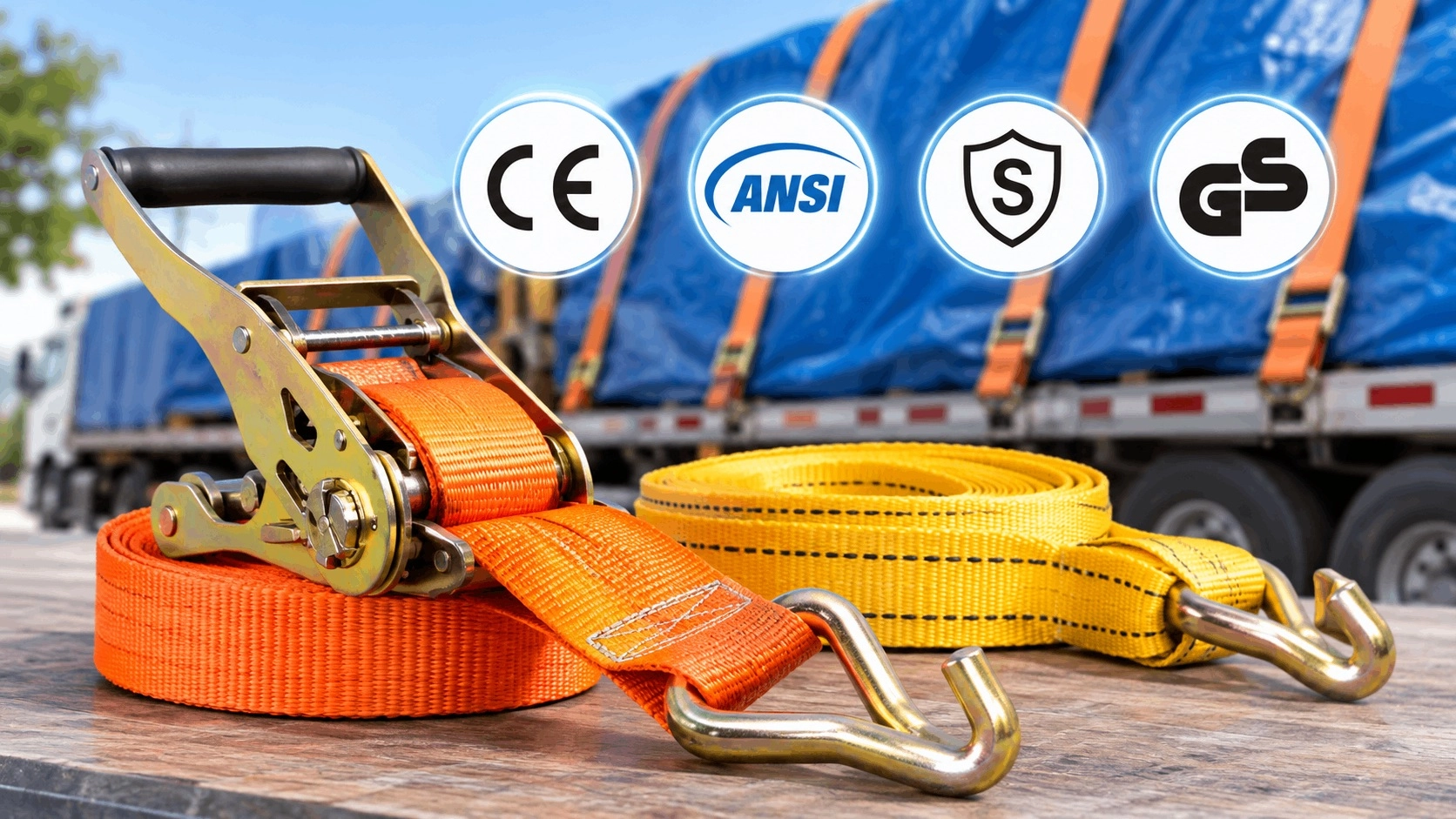
1. Why Certifications Matter When Buying Tie-Down Straps
Certifications and compliance documents help buyers assess whether a product has been designed, manufactured, or tested according to specified requirements.
For commercial buyers, they provide useful information about product performance and manufacturing processes. They can also help distributors and importers meet customer expectations and applicable market requirements.
There are several reasons why certification matters.
Verifying Product Performance
A tie-down strap may look strong and well-made, but its actual load-bearing performance cannot be determined by appearance alone.
Relevant standards establish testing methods and performance requirements for specific product categories. These requirements help evaluate characteristics such as lashing capacity, breaking strength, elongation, and the performance of the complete assembly.
Supporting Transportation Safety
Cargo restraint products must perform reliably under their intended operating conditions.
Properly tested heavy-duty tie-down straps help businesses make informed decisions about product suitability and reduce the risk of relying on unverified performance claims.
However, certification alone does not guarantee safe use. Correct strap selection, installation, inspection, and cargo-securing procedures remain essential.
Meeting Import and Market Requirements
Different countries and regions may have specific requirements for cargo securing equipment.
Importers and distributors should understand which standards apply to their target markets and whether additional documentation is required.
Improving Supplier Reliability
A manufacturer that maintains documented quality control procedures and provides traceable test information is generally easier to evaluate than a supplier that offers only verbal performance claims.
For businesses purchasing tie-down straps in bulk, this information can support supplier assessment, incoming quality inspection, and long-term procurement management.
2. EN 12195-2: An Important Standard for Web Lashings
One of the most relevant standards to understand when purchasing tie-down straps for European road transportation is EN 12195-2.
Its full scope concerns web lashings made from man-made fibres for securing loads on road vehicles. It specifies requirements and test methods for these products.
This standard is particularly relevant to polyester and other synthetic webbing-based cargo restraint assemblies.
What Does EN 12195-2 Cover?
EN 12195-2 addresses important characteristics of web lashings, including:
Material and construction requirements.
Lashing capacity and breaking force.
Elongation characteristics.
Performance of lashing components.
Marking and identification information.
Relevant testing procedures.
These requirements help buyers evaluate whether a web lashing assembly is suitable for its intended application.
What Information Should Be Included on the Label?
When examining a tie-down strap manufactured to the applicable requirements of EN 12195-2, buyers should pay attention to product identification and capacity information.
Depending on the product and applicable requirements, markings may include:
Lashing capacity (LC).
Standard hand force (SHF).
Standard tension force (STF), where applicable.
Webbing material.
Manufacturer or supplier identification.
Applicable standard reference.
Length information.
Traceability or product identification details.
These markings help users identify the product and understand its rated characteristics.
It is important to distinguish between LC, STF, and breaking strength. They describe different aspects of a lashing system and should not be treated as interchangeable values.
Is EN 12195-2 Relevant to Every Tie-Down Strap?
No. Its scope is specific to web lashings made from man-made fibres for load restraint on road vehicles.
Buyers should confirm whether the particular product falls within the standard's scope rather than assuming that every strap with a ratchet buckle or hook automatically complies.
For example, a general-purpose luggage strap and a commercial road-transport web lashing may have very different intended uses and compliance requirements.
3. WSTDA-T1: An Important Reference for the North American Market
For buyers sourcing tie-down straps for the US market, the Web Sling & Tie Down Association (WSTDA) is another important organization to know.
WSTDA develops industry recommendations and technical specifications for web slings and synthetic web tie-down products.
One relevant document is WSTDA-T1: Recommended Standard Specification for Synthetic Web Tie Downs.
This specification addresses synthetic web tie-down assemblies and provides technical guidance for evaluating their construction and performance.
What Should Buyers Check Under WSTDA-T1?
When sourcing synthetic web tie-downs, buyers should pay attention to:
Webbing material and construction.
Assembly breaking strength.
Working load limit.
Stitching and connection quality.
Hardware performance.
Product identification and marking.
Testing and inspection documentation.
The standard is particularly relevant to businesses purchasing ratchet tie-down straps, cam buckle straps, and other synthetic web restraint assemblies.
Is WSTDA-T1 a Product Certification?
Not exactly. WSTDA-T1 is a recommended technical specification, rather than a standalone certification issued to every manufacturer.
However, it has regulatory relevance in the United States. The US cargo securement regulations under 49 CFR 393.104 reference WSTDA-T1 for synthetic web tiedowns used in commercial motor vehicles. Buyers should verify the applicable regulatory version and product requirements for their intended use.
GovInfo+1
4. FMCSA Cargo Securement Regulations: Requirements for US Transportation
For companies transporting cargo on commercial motor vehicles in the United States, the Federal Motor Carrier Safety Administration (FMCSA) provides important cargo securement regulations.
The relevant requirements are found in 49 CFR Part 393, Subpart I, which covers cargo securement systems and equipment.
Unlike EN 12195-2, which is a technical standard for web lashings, FMCSA regulations establish requirements for how cargo and restraint devices must perform during commercial road transportation.
Key FMCSA Requirements
Several sections are particularly relevant to tie-down strap buyers and users.
49 CFR 393.102 – Minimum Performance Criteria
This section establishes performance criteria for cargo securement devices and systems, including requirements relating to breaking strength and working load limits.
It addresses the forces that cargo securement systems must withstand under specified forward, rearward, and lateral acceleration or deceleration conditions.
49 CFR 393.104 – Standards for Cargo Securement Devices and Systems
This section addresses the condition and construction of cargo securing equipment. It also references applicable manufacturing standards for different types of tiedown assemblies, including synthetic webbing.
49 CFR 393.106 – General Requirements for Securing Cargo
This section covers general cargo restraint requirements, including the aggregate working load limit of tiedowns and methods for calculating their contribution to the overall restraint system.
For example, the regulation establishes an aggregate working load limit requirement of at least one-half the weight of the cargo being secured, subject to the calculation rules for different tiedown configurations.
LII / Legal Information Institute+2
What Does This Mean for Buyers?
When purchasing heavy-duty tie-down straps for the US market, buyers should ask suppliers whether the products are designed and tested to meet the applicable requirements.
They should also verify that the working load limit is clearly identified and that the complete assembly, including webbing, stitching, hooks, and ratchet mechanisms, is suitable for the intended application.
It is important to remember that FMCSA compliance is not simply a certificate attached to a strap. It involves the performance of the complete cargo securing system and its correct use during transportation.
5. AS/NZS 4380: Considerations for the Australian and New Zealand Markets
For businesses sourcing cargo restraint products for Australia and New Zealand, AS/NZS 4380 is another standard worth investigating.
It relates to transport webbing and components used in motor vehicle cargo restraint systems.
The standard is relevant to webbing assemblies incorporating components such as tensioning devices and end fittings.
When evaluating products for this market, buyers should investigate:
Webbing material and construction.
Lashing capacity.
Assembly configuration.
Tensioning device compatibility.
End fitting performance.
Product labeling and traceability.
Relevant test documentation.
The National Heavy Vehicle Regulator (NHVR) provides guidance on webbing assemblies and their use in load restraint systems. Its guidance emphasizes the importance of suitable rated webbing assemblies and clearly identified lashing capacity.
nhvr.gov.au
Important: Standards can be revised, replaced, or withdrawn. Buyers should confirm the current status of AS/NZS 4380 and the applicable requirements with the relevant standards authority before specifying it in a purchase contract.
6. ISO 9001: Evaluating a Tie-Down Strap Manufacturer's Quality Management System
Product-specific standards are important, but buyers should also evaluate the manufacturer's production and quality management capabilities.
ISO 9001 is an internationally recognized quality management system standard. It provides a framework for organizations to establish, implement, maintain, and continually improve their quality management systems.
For a tie-down strap manufacturer, an ISO 9001-certified quality management system can indicate that documented procedures are in place for production control, inspection, corrective actions, and customer feedback.
Why Is ISO 9001 Relevant to Tie-Down Strap Purchasing?
The manufacturing process of a tie-down strap involves multiple stages, including:
Selection and inspection of raw materials.
Webbing weaving and processing.
Cutting and dimensional control.
Sewing and reinforcement.
Ratchet and hook assembly.
Finished product inspection.
Product packaging and identification.
A structured quality management system can help manufacturers maintain consistency throughout these stages.
For wholesale buyers, this is particularly important when ordering large quantities or arranging long-term supply agreements.
Does ISO 9001 Mean the Product Is Certified?
No. This distinction is essential.
ISO 9001 certifies an organization's quality management system, not the individual tie-down strap or its load-bearing capacity. A manufacturer holding an ISO 9001 certificate does not automatically prove that every product meets EN 12195-2, WSTDA-T1, or another applicable product specification.
ISO
Therefore, buyers should evaluate ISO 9001 alongside product-specific test reports and compliance documentation.
7. Test Reports and Performance Verification
Certifications are useful, but testing documentation provides additional information about how a specific tie-down strap performs.
When purchasing heavy-duty cargo tie-down straps, buyers should request relevant test reports rather than relying entirely on product descriptions or marketing claims.
Depending on the applicable standard and product design, testing may cover several important characteristics.
Breaking Strength Testing
Breaking strength testing evaluates the maximum force a strap assembly can withstand before failure under specified test conditions.
The test should consider the complete assembly where required, including the webbing, stitching, ratchet, and end fittings.
This is important because a strong webbing material does not guarantee that the finished strap assembly has the same strength.
Working Load Limit Verification
The working load limit is the rated capacity assigned to a component or assembly for its intended use.
Buyers should confirm that the stated WLL is supported by appropriate product specifications and testing.
It should not be confused with breaking strength or lashing capacity, as these terms are used differently across standards and applications.
Elongation Testing
Elongation testing measures how much the webbing stretches under specified loading conditions.
This information is useful when comparing polyester and nylon tie-down straps because the two materials have different stretching characteristics.
Stitching and Hardware Testing
The connection between webbing and hardware is a critical part of the complete assembly.
Testing and inspection should consider stitching consistency, hook strength, ratchet operation, and the integrity of connecting components.
Environmental Performance Testing
Depending on the intended application, buyers may also request information about resistance to UV exposure, moisture, abrasion, and other environmental conditions.
Not every test is required for every product. The appropriate testing program should be based on the applicable standard and actual operating environment.
8. Be Careful When Evaluating CE and Other Compliance Claims
Some suppliers advertise CE marking or provide general conformity documents when selling cargo securing products. Buyers should understand what these documents actually demonstrate.
CE marking is required only for products covered by applicable European Union harmonization legislation. It is not a universal quality mark for every industrial product.
For ordinary textile cargo tie-down straps, buyers should not automatically assume that CE marking is required or that a CE certificate proves compliance with EN 12195-2.
Similarly, a generic certificate or declaration should not be accepted without checking:
The exact product covered by the document.
The applicable regulation or standard.
The issuing or testing organization.
The certificate's validity and scope.
Whether the document relates to the complete strap assembly.
Whether the stated model and specifications match the purchased product.
A reliable supplier should be able to explain which standards apply to its products and provide appropriate supporting documentation.
9. What Documents Should You Request from a Tie-Down Strap Supplier?
When purchasing tie-down straps for wholesale distribution, commercial transportation, or industrial applications, requesting the right documents can help reduce procurement risks.
The following checklist provides a practical starting point.
Document | What It Helps Verify |
|---|---|
Product specification sheet | Material, dimensions, capacity, and construction |
EN 12195-2 test report, where applicable | Performance against European web lashing requirements |
WSTDA-T1 test documentation, where applicable | Synthetic web tie-down performance |
Working load limit information | Rated capacity of the assembly |
Breaking strength test report | Resistance to failure under specified testing conditions |
ISO 9001 certificate | Manufacturer's quality management system |
Material documentation | Webbing and hardware specifications |
Product inspection records | Manufacturing and quality consistency |
Product labels and traceability information | Product identification and capacity details |
Not every purchase requires every document. The documentation should match the product, destination market, and intended application.
For example, a distributor sourcing polyester ratchet straps for European road transportation may prioritize EN 12195-2-related documentation, while a buyer supplying the US commercial transportation market may need to examine WSTDA-T1 and applicable FMCSA requirements.
10. How to Verify the Authenticity of Certifications
Receiving a certificate from a supplier is only the first step. Buyers should also verify that the document is genuine and relevant.
Here are several practical verification methods.
Check the Issuing Organization
Identify the organization that issued the certificate or test report. Determine whether it is a recognized certification body or testing laboratory with relevant technical capabilities.
For testing laboratories, ISO/IEC 17025 accreditation can be useful when evaluating the laboratory's competence for the specific tests involved.
However, accreditation should be checked against the laboratory's actual scope. A laboratory may be accredited for certain tests but not for every type of cargo restraint testing.
Confirm the Product Model
Make sure the certificate or report identifies the correct product type, model, material, and configuration.
A test report for one ratchet strap design should not automatically be applied to every strap manufactured by the same supplier.
Changes in webbing width, stitching, hardware, or assembly design may affect product performance.
Check the Validity and Scope
Review the issue date, applicable standard edition, testing conditions, and any limitations.
If the certificate has an expiration date or requires periodic reassessment, confirm that it remains valid.
Request Additional Test Information
If the supplied document does not provide sufficient detail, ask for supporting information such as test results, product photographs, and technical specifications.
A professional tie-down straps manufacturer should be able to explain its product testing procedures and provide documentation relevant to the products being supplied.
11. Common Mistakes When Choosing Certified Tie-Down Straps
Even experienced buyers can make mistakes when evaluating product certifications.
Understanding these common issues can help businesses improve their purchasing decisions.
Assuming ISO 9001 Certifies the Product
ISO 9001 relates to quality management systems rather than the load-bearing performance of individual tie-down straps.
Buyers should request product-specific test reports in addition to checking the manufacturer's management system certification.
Treating Breaking Strength as Working Load Limit
Breaking strength and working load limit are different specifications.
A strap's breaking strength does not represent the load that should be applied during normal use.
Always check the correct rated capacity and the applicable lashing or cargo restraint requirements.
Accepting Generic Certificates
A certificate that does not identify the actual product, model, or relevant standard provides limited evidence of compliance.
Documentation should be traceable to the specific product being purchased.
Ignoring Market-Specific Standards
A product suitable for one market may not automatically satisfy the requirements of another.
European, North American, and Australian markets have different technical standards and regulatory frameworks.
Overlooking Product Construction
A certificate cannot compensate for unsuitable product selection or improper use.
Webbing quality, stitching, hardware, anchor point compatibility, and correct installation remain essential.
12. How to Choose a Reliable Certified Tie-Down Strap Manufacturer
For importers, distributors, wholesalers, and industrial buyers, choosing the right manufacturer involves more than comparing product prices and advertised capacities.
A reliable supplier should provide transparent product information and demonstrate the ability to maintain consistent manufacturing quality.
Consider the following factors when evaluating potential suppliers.
1. Product testing capabilities
Ask whether the manufacturer conducts regular performance testing and whether it can provide relevant test reports for different strap specifications.
2. Manufacturing consistency
Evaluate how the company controls raw materials, webbing production, stitching, hardware assembly, and finished product inspection.
3. Product customization
If your business requires specific strap lengths, webbing widths, hook configurations, or private-label packaging, confirm whether the manufacturer can support these requirements while maintaining the necessary performance specifications.
4. Documentation transparency
A professional supplier should provide clear product specifications, relevant compliance documentation, and traceability information.
5. Experience with international markets
For overseas buyers, experience with different market requirements can help simplify product selection, documentation preparation, and long-term cooperation.
6. After-sales support
A dependable manufacturer should be willing to address technical questions, product feedback, and quality concerns throughout the cooperation process.
Establishing a long-term relationship with a qualified tie-down straps supplier can help businesses maintain product consistency and reduce procurement uncertainty.
Conclusion
Choosing tie-down straps with appropriate certifications and supporting documentation is an important part of responsible cargo securing procurement. EN 12195-2, WSTDA-T1, and relevant regional cargo securement regulations provide useful references for evaluating product performance in different markets. Meanwhile, ISO 9001 can help buyers assess a manufacturer's quality management system, although it does not replace product-specific testing.
For businesses sourcing reliable cargo securing products, Zhongyi recognizes the importance of material quality, manufacturing consistency, and clear product specifications. Whether purchasing ratchet straps, heavy-duty cargo tie-down straps, or customized webbing assemblies, buyers should evaluate the applicable standards and technical documentation to ensure that the selected products meet their transportation and application requirements. Working with a professional manufacturer that understands these requirements can help distributors, wholesalers, and commercial customers build more dependable long-term supply relationships.