
 EN
 Italian
 Spanish
 Turkish
 Japanese
 Portuguese
 Dutch
 Korean
 Russian
 French
 German
 Arabic
 Indonesian



 ALL

 Company News

 Industry News

 Product Knowledge
How to Select Tie-Down Straps for Heavy-Duty Applications?
Nov. 04, 2026
Views:2
Securing heavy cargo during transportation requires more than simply choosing a strap with a high breaking strength. Whether transporting industrial machinery, construction equipment, steel materials, agricultural machines, or oversized goods, the right cargo restraint system plays an important role in preventing load movement and reducing transportation risks. Selecting unsuitable straps can lead to excessive tension, webbing damage, hardware failure, or unstable cargo during transit.
For businesses involved in logistics, manufacturing, construction, and equipment transportation, choosing reliable heavy-duty tie-down straps is an essential part of daily operations. Different loads require different strap capacities, webbing materials, widths, lengths, and fastening mechanisms. A strap designed for lightweight cargo may not provide sufficient restraint for heavy machinery, while an unnecessarily large strap may create handling difficulties or fail to fit the available securing points.
So, how should buyers select tie-down straps for heavy-duty applications? The key is to understand the cargo characteristics, calculate the required working load limit, evaluate the webbing and hardware, and consider the actual transportation environment. This guide explains the major factors to help businesses make informed purchasing decisions.
1. Understand the Requirements of Heavy-Duty Cargo
Before purchasing tie-down straps, the first step is to identify the characteristics of the cargo being transported. Weight is important, but it is not the only factor that determines the type of restraint equipment required.
Different types of cargo create different securing challenges.
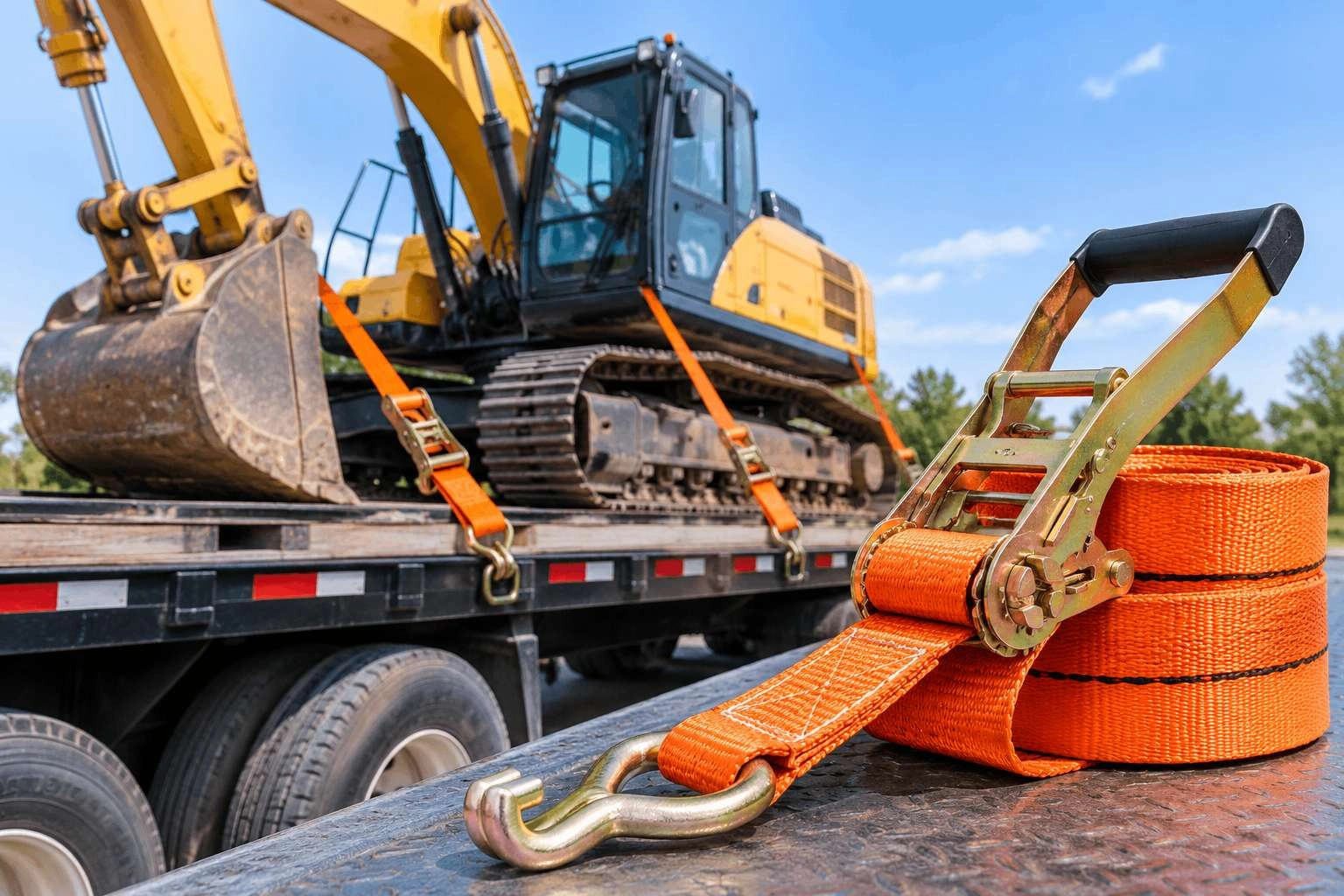
For example, industrial machinery may have a high weight and an irregular shape, requiring multiple securing points. Steel pipes and metal components may have sharp edges that can damage webbing. Construction equipment may be transported on flatbed trailers and exposed to vibration, road impacts, and changing weather conditions.
When evaluating cargo requirements, consider the following factors:
Cargo weight: Determine the total weight of the load and how it will be distributed across the securing points.
Cargo dimensions: Large or irregularly shaped items may require longer straps or multiple restraint positions.
Surface characteristics: Sharp edges, rough surfaces, and protruding components can increase the risk of strap abrasion or cutting.
Center of gravity: Cargo with a high or uneven center of gravity may require additional restraint to prevent tipping or shifting.
Transportation distance: Long-distance transportation exposes cargo to repeated vibration and changing road conditions.
Loading and unloading methods: Forklifts, cranes, and other equipment may influence the available attachment points and strap arrangement.
Understanding these details helps buyers determine whether standard ratchet straps are sufficient or whether specialized industrial cargo tie-down straps are needed.
2. Check the Working Load Limit (WLL)
The working load limit is one of the most important specifications when selecting heavy-duty tie-down straps.
WLL refers to the maximum load that a strap is designed to secure under specified conditions. It should not be confused with breaking strength, which refers to the force at which the strap is expected to fail under a particular test condition.
Some buyers focus primarily on advertised breaking strength because larger numbers may appear more impressive. However, breaking strength alone does not tell users how much cargo a strap can safely restrain during normal operation.
When selecting heavy-duty ratchet tie-down straps, buyers should pay attention to:
Rated working load limit.
Breaking strength.
Strap configuration and attachment method.
Applicable safety standards and regulations.
Manufacturer specifications and product labeling.
It is also important to understand that the load capacity of a complete tie-down assembly depends on its components. The webbing, stitching, ratchet, hooks, and other fittings must all be suitable for the intended application.
The overall restraint system should never be assumed to have a capacity greater than its weakest component.
Consider the Number of Straps Required
The number of straps needed depends on cargo weight, dimensions, restraint method, transportation regulations, and the load distribution between securing points.
Adding more straps does not automatically make a load secure. Each strap must be correctly positioned, tensioned, and attached to suitable anchor points.
For commercial transportation, buyers should work with qualified personnel to determine the appropriate restraint arrangement according to the applicable cargo-securing requirements.
3. Choose the Right Webbing Material
The material used in tie-down straps directly affects their strength, flexibility, stretch, moisture resistance, and durability.
Polyester and nylon are two common synthetic materials used in cargo securing products. Both can provide good mechanical performance, but their characteristics make them suitable for different operating conditions.
Polyester Tie-Down Straps
Polyester is widely used in heavy-duty cargo securing applications because of its relatively low elongation and good resistance to moisture.
Its main advantages include:
Low stretch under normal loading conditions.
Good resistance to moisture absorption.
Generally good UV resistance.
Reliable dimensional stability.
Good resistance to many common environmental conditions.
Because polyester stretches relatively little under tension, it can help maintain stable cargo restraint during transportation.
Polyester tie-down straps are particularly suitable for flatbed trailers, industrial equipment, machinery transportation, and general commercial freight applications.
Nylon Tie-Down Straps
Nylon is known for its elasticity, toughness, and tensile performance. Compared with polyester, nylon generally stretches more when subjected to tension.
This elasticity can help absorb some sudden loading forces and accommodate movement in certain applications.
However, nylon absorbs more moisture than polyester, and its properties may change when wet. Prolonged exposure to sunlight and certain chemicals can also affect its service life.
For applications where flexibility and shock absorption are important, nylon may be worth considering. However, buyers should evaluate its higher elongation carefully, particularly when stable cargo positioning is required.
Which Material Is Better for Heavy-Duty Applications?
For many general heavy-duty transportation applications, polyester is often a practical choice because of its low stretch, moisture resistance, and outdoor durability.
Nylon may be appropriate for applications that benefit from greater elasticity.
The final selection should depend on the actual cargo, transportation environment, and product specifications rather than assuming that one material is always superior.
4. Select the Appropriate Strap Width and Length
Strap dimensions have a direct influence on handling, compatibility, and load-securing performance.
Heavy-duty tie-down straps are available in different widths and lengths to accommodate various cargo sizes and restraint requirements.
Strap Width
Wider webbing generally provides a larger contact area and can help distribute pressure across the cargo surface. It may also be manufactured with a higher rated capacity, depending on the material and construction.
However, width alone does not determine strength.
When selecting the appropriate width, consider:
Required working load limit.
Cargo dimensions and weight.
Available anchor points.
Compatibility with ratchet mechanisms and hooks.
Contact pressure on the cargo surface.
Ease of handling and storage.
For large machinery and industrial equipment, wider heavy-duty webbing may be suitable when the product specifications meet the required load capacity.
Strap Length
The correct strap length depends on the cargo dimensions, trailer configuration, and securing method.
Straps that are too short may not reach the designated anchor points. Excessively long straps can create unnecessary loose webbing, making installation and storage more difficult.
Before purchasing heavy-duty cargo tie-down straps, measure the distance between the intended attachment points and account for the routing path around the load.
For businesses that frequently transport different cargo sizes, maintaining several strap lengths can improve operational flexibility.
5. Choose the Right Tie-Down Mechanism
The fastening mechanism determines how tension is applied and maintained. Different mechanisms are designed for different cargo weights and operating requirements.
Ratchet Tie-Down Straps
Ratchet straps are among the most widely used cargo securing products for heavy-duty transportation.
They use a mechanical ratcheting mechanism to tighten the webbing and maintain tension. This allows operators to secure cargo more efficiently than with simple manual fastening methods.
Common applications include:
Industrial machinery transportation.
Flatbed truck cargo securing.
Construction equipment transportation.
Heavy materials and commercial freight.
Agricultural machinery transportation.
When choosing heavy-duty ratchet tie-down straps, pay attention to the ratchet handle construction, gear mechanism, corrosion resistance, webbing compatibility, and hook strength.
The ratchet should operate smoothly and maintain tension without slipping or showing signs of deformation.
Cam Buckle Straps
Cam buckle straps use a spring-loaded buckle to hold the webbing in place. They are generally easier to adjust manually but usually provide less mechanical tightening force than ratchet straps.
They are more commonly used for lightweight or moderate-duty applications, depending on their rated capacity.
For particularly heavy cargo, ratchet mechanisms are often more suitable because they allow controlled tensioning with less manual effort.
Winch Straps
Winch straps are commonly used with trailer-mounted winches, especially in flatbed transportation.
They allow operators to secure larger loads using a fixed winch system. Their webbing dimensions, end fittings, and rated capacity should be compatible with the winch and intended cargo restraint arrangement.
For logistics companies transporting heavy industrial materials, winch straps can provide an efficient solution for repeated loading and unloading operations.
6. Pay Attention to Hooks and Metal Fittings
The hardware attached to a tie-down strap is just as important as the webbing itself.
Even if the webbing has sufficient strength, unsuitable hooks or poorly manufactured metal fittings can compromise the complete assembly.
Common hardware options include:
J-hooks: Frequently used with compatible trailer anchor points.
Flat hooks: Suitable for certain flatbed trailer securing systems.
Wire hooks: Designed for specific attachment configurations.
Snap hooks: Provide a convenient connection where compatible attachment points are available.
D-rings: Used in certain cargo restraint configurations and attachment systems.
When evaluating heavy-duty tie-down strap hardware, consider the following factors.
Material quality: Metal fittings should be manufactured from materials suitable for the expected loads and operating environment.
Corrosion resistance: Coatings or suitable material selection can help reduce corrosion during outdoor use.
Compatibility: Hooks must fit the designated anchor points without improper positioning or excessive movement.
Structural integrity: Inspect welds, connecting points, and moving components for defects or deformation.
The hardware should always be selected as part of a complete rated assembly rather than treated as an interchangeable accessory.
7. Evaluate Stitching and Webbing Construction
The quality of stitching is another important consideration when purchasing heavy-duty tie-down straps.
The webbing and its connection points must work together to withstand the forces generated during cargo restraint.
Poor stitching can become a weak point even when the webbing material itself has excellent tensile properties.
Buyers should evaluate:
Stitching consistency.
Thread quality.
Reinforcement around attachment points.
Webbing edge finishing.
Overall weaving uniformity.
Resistance to abrasion and repeated handling.
Reinforced stitching is particularly important around the areas connecting the webbing to ratchets, hooks, and other fittings.
For businesses purchasing industrial tie-down straps in bulk, checking manufacturing consistency across different production batches is also essential.
8. Consider the Transportation Environment
Heavy-duty tie-down straps are used in many different environments. A product that performs well in a dry indoor facility may face different challenges when used on an outdoor flatbed trailer.
Environmental conditions can influence webbing performance and product lifespan.
Outdoor Exposure
UV radiation can gradually weaken synthetic fibers. For straps used frequently outdoors, materials with good UV resistance are preferable.
Polyester is generally a suitable option for this type of application.
Rain and Humidity
Moisture can affect different synthetic fibers in different ways. Polyester has relatively low moisture absorption, making it useful for wet and humid transportation environments.
Regardless of material, straps should be dried properly before long-term storage.
High and Low Temperatures
Extreme temperatures can affect both webbing and metal hardware. Buyers should check the manufacturer's recommended operating temperature range, especially when transporting cargo in demanding industrial environments.
Dust and Abrasive Conditions
Construction sites, mining operations, and industrial facilities may expose straps to dust, dirt, and abrasive particles.
Regular cleaning and inspection help identify damage before it becomes a more serious problem.
9. Check Relevant Standards and Product Certifications
For commercial and industrial transportation, compliance is an important part of purchasing decisions.
Different markets and applications may have specific requirements governing cargo restraint equipment.
Depending on the destination market and intended use, buyers may need to consider relevant standards such as EN 12195-2 for web lashings made from man-made fibres.
When evaluating a supplier, request appropriate documentation and verify that the product specifications match the applicable requirements.
Important information may include:
Working load limit.
Standard lashing capacity where applicable.
Breaking strength.
Material specifications.
Product identification and labeling.
Test reports or conformity documentation.
Manufacturer quality control procedures.
It is important not to assume that every product complies with a particular standard simply because it is described as heavy-duty.
Buyers should verify the actual documentation for the specific product and configuration.
10. Consider Customization Requirements
Standard tie-down straps are suitable for many applications, but some businesses require products designed around specific transportation equipment or cargo dimensions.
Custom tie-down straps can help address these requirements.
Common customization options include:
Webbing width and length: Different dimensions can be selected according to cargo size and installation requirements.
Webbing color: Different colors can help businesses distinguish between strap specifications or product categories.
Hook configurations: Different end fittings can be selected to match compatible anchor points.
Ratchet specifications: Ratchet size, handle design, and hardware configuration can be adjusted according to product requirements.
Branding: Custom labels, packaging, and other identification options can support private-label and wholesale purchasing programs.
For distributors, transportation companies, and equipment manufacturers, working with a supplier that offers flexible customization can simplify product sourcing.
However, any modification involving webbing, stitching, hardware, or assembly configuration should be properly evaluated and tested. Customization should never compromise the rated capacity or safety requirements of the finished product.
11. Inspect Tie-Down Straps Before Every Use
Even high-quality heavy-duty tie-down straps require regular inspection.
Repeated loading, friction, environmental exposure, and improper handling can gradually damage the webbing and hardware.
Before each use, check the following areas:
Webbing: Look for cuts, fraying, excessive abrasion, melted fibers, or other visible damage.
Stitching: Check for broken threads, loose seams, or damaged reinforcement.
Hooks: Look for cracks, deformation, corrosion, or other structural damage.
Ratchet mechanisms: Ensure that moving parts operate properly and that the locking mechanism functions as intended.
Labels: Confirm that the product identification and capacity information remain readable.
Any strap showing damage that could affect its strength should be removed from service according to the applicable inspection and retirement criteria.
Do not attempt to repair damaged load-bearing webbing with ordinary stitching or makeshift methods.
12. Common Mistakes When Buying Heavy-Duty Tie-Down Straps
Choosing the wrong product can lead to unnecessary replacement costs and potential cargo safety problems.
Several purchasing mistakes are particularly common.
Choosing Based Only on Breaking Strength
A high breaking strength does not automatically mean that a strap is suitable for a particular load. Buyers should understand the working load limit and the rated capacity of the complete assembly.
Ignoring Cargo Characteristics
The same strap may not be suitable for machinery, metal pipes, vehicles, and palletized goods. Cargo shape, weight distribution, and surface conditions all influence product selection.
Overlooking Hardware Quality
Low-quality ratchets and hooks can compromise an otherwise well-manufactured strap. The entire assembly needs to meet the intended requirements.
Selecting the Wrong Length
Incorrect strap dimensions can make installation difficult and reduce operational efficiency.
Focusing Only on Purchase Price
Low-cost products may not provide consistent webbing quality, stitching, or hardware performance. For businesses purchasing in large quantities, long-term durability and manufacturing consistency should also be considered.
13. How to Choose a Reliable Heavy-Duty Tie-Down Strap Manufacturer
For wholesalers, distributors, and commercial buyers, choosing a dependable manufacturer is just as important as selecting the correct product specifications.
A professional manufacturer should be able to provide clear technical information and support buyers throughout the product selection process.
Here are several factors worth evaluating.
Product range: Check whether the manufacturer offers different types of ratchet straps, cam buckle straps, winch straps, and other cargo securing products.
Manufacturing capabilities: Evaluate production equipment, webbing manufacturing processes, stitching operations, hardware assembly, and quality inspection procedures.
Quality control: Ask how the manufacturer checks tensile performance, stitching quality, hardware integrity, and product consistency.
Customization services: If your business requires private-label products or specific strap configurations, confirm whether the manufacturer can support these requirements.
Export experience: For international buyers, experience with export packaging, product documentation, and overseas customer requirements can make cooperation more efficient.
Communication and technical support: A responsive supplier should be able to explain product specifications and help buyers identify suitable configurations for their applications.
Building a long-term relationship with a reliable tie-down straps manufacturer can help businesses maintain consistent product quality and improve procurement efficiency.
Frequently Asked Questions About Heavy-Duty Tie-Down Straps
1. What is the most important specification when choosing heavy-duty tie-down straps?
The working load limit is one of the most important specifications because it indicates the rated capacity of the strap under specified conditions. Buyers should also consider breaking strength, webbing material, hardware, stitching, and the complete restraint configuration.
2. Are polyester tie-down straps suitable for heavy machinery?
Yes. Polyester webbing is commonly used for heavy-duty cargo securing because of its relatively low stretch, moisture resistance, and good UV resistance. The selected strap must have an appropriate working load limit and compatible hardware for the specific application.
3. Are wider tie-down straps always stronger?
Not necessarily. Wider webbing may provide a larger contact area and can support higher capacities depending on its construction. However, strength also depends on fiber quality, weaving structure, stitching, and hardware.
4. How often should heavy-duty tie-down straps be inspected?
Tie-down straps should be inspected before each use. Commercial users may also establish regular inspection procedures based on usage frequency, operating conditions, and applicable safety requirements.
5. Can tie-down straps be customized for industrial applications?
Yes. Depending on the manufacturer's capabilities, customization may include webbing dimensions, material, colors, hooks, ratchet mechanisms, labels, and packaging. Any customized load-bearing configuration should be appropriately evaluated and tested before use.
Conclusion
Selecting the right tie-down straps for heavy-duty applications requires a comprehensive evaluation of cargo weight, working load limit, webbing material, strap dimensions, fastening mechanisms, hardware quality, and transportation conditions. Polyester is often a practical choice for applications requiring low stretch and good environmental resistance, while nylon may be suitable when greater elasticity is needed. Beyond material selection, the quality of stitching, metal fittings, and overall assembly also plays an important role in reliable cargo restraint.
For businesses sourcing dependable cargo securing products, Zhongyi offers tie-down strap solutions for different transportation and industrial requirements. With attention to product construction, material selection, and application-specific needs, Zhongyi supports distributors, wholesalers, and commercial customers looking for reliable heavy-duty tie-down straps and customized cargo securing solutions.
RELATED NEWS
-
 Industry News Jul. 04, 2025Inside the Standard: EN 12195-2 and What It Means for Web Lashing SafetyRead More

-
 Industry News Jul. 04, 2025Why Round Slings Are a Go-To Solution for Modern, Complex LiftsRead More
-
 Industry News Jul. 04, 2025Tech Advancements: The Evolution of Tensioning Devices in Load SecurementRead More


