

 EN



 ALL

 Company News

 Industry News

 Product Knowledge
How to Choose the Right Tie-Down Straps for Your Cargo?
Oct. 22, 2026
Views:13
Choosing the right tie-down straps is essential for keeping cargo secure during transportation, storage, and handling. Whether you are moving furniture, transporting construction materials, securing equipment on a trailer, or managing goods in a logistics operation, the straps you use can directly affect load stability and transportation safety. Selecting an unsuitable strap may result in shifting cargo, damaged goods, or equipment failure during transit.
With various materials, fastening mechanisms, lengths, widths, and load ratings available, finding the right tie-down straps requires more than simply choosing a product that looks strong. Buyers need to consider cargo weight, dimensions, shape, transportation conditions, and the type of anchor points available on the vehicle or trailer.
For businesses, fleet operators, distributors, and individual users, understanding these factors helps improve cargo control and reduce avoidable transportation risks. This guide explains how to choose tie-down straps for different cargo types, compare common strap designs, evaluate load ratings, and identify the most suitable products for specific applications.
1. Understand the Weight and Characteristics of Your Cargo
The first step in choosing the right tie-down straps is understanding what you need to secure. Cargo weight is important, but it is not the only factor that determines which straps are appropriate.
The dimensions, shape, surface characteristics, and center of gravity of the load also influence the securing method.
Determine the Total Cargo Weight
Before selecting heavy-duty tie-down straps, establish the total weight of the cargo being transported. This information helps determine the required load-securing capacity and the number of straps needed.
For example, securing lightweight cartons requires a different approach from securing industrial machinery or heavy construction materials. A strap suitable for small packages may not provide sufficient capacity for bulky or heavy equipment.
Always consider the actual working load limit (WLL) of the strap and the requirements of the applicable cargo-securing regulations. Do not select straps based solely on their advertised breaking strength.
The breaking strength describes the force at which a strap assembly may fail under specified test conditions. The working load limit is the maximum load permitted for normal use under the manufacturer's stated conditions. These figures are not interchangeable.
Consider the Cargo Shape and Surface
Cargo shape affects how tie-down straps contact the load and how easily the load can move during transportation.
Regularly shaped cargo: Boxes, pallets, and rectangular containers are generally easier to secure with conventional tie-down straps.
Irregularly shaped cargo: Machinery, automotive components, and equipment with protruding parts may require multiple securing points or specialized arrangements.
Fragile cargo: Furniture, appliances, and finished products may need protective sleeves, edge guards, or padding to prevent strap pressure from damaging surfaces.
Rounded cargo: Pipes, logs, and cylindrical products may require suitable restraint arrangements to prevent rolling or lateral movement.
Understanding these characteristics before purchasing cargo tie-down straps helps you select the appropriate strap width, fastening mechanism, and accessories.
2. Choose the Right Tie-Down Strap Material
Material selection affects the strength, flexibility, moisture resistance, abrasion resistance, and service life of tie-down straps. Polyester and nylon are common choices, while polypropylene is used in certain lighter-duty applications.
Polyester Tie-Down Straps
Polyester tie-down straps are widely used for road transportation, warehouse handling, industrial equipment, and general cargo securing.
Their key characteristics include relatively low moisture absorption, good resistance to stretching under load, and useful resistance to many environmental conditions encountered during transportation.
Because polyester generally retains its dimensions well under changing humidity, it is often a practical option for applications where stable restraint is important. Polyester webbing is also available in different widths, thicknesses, colors, and load ratings.
These characteristics make polyester cargo straps suitable for many commercial transportation and logistics applications. However, the actual performance depends on webbing construction, stitching quality, hardware, and the complete strap assembly.
Nylon Tie-Down Straps
Nylon webbing is known for its strength and elasticity. Its ability to stretch can be useful in some applications, but excessive movement may be undesirable when cargo must remain firmly positioned.
Nylon also absorbs more moisture than polyester, which can influence its dimensions and mechanical behavior in wet conditions.
When comparing nylon and polyester tie-down straps, buyers should evaluate the operating environment and the requirements of the load rather than assuming that one material is always superior.
Polypropylene Tie-Down Straps
Polypropylene webbing is lightweight and can offer useful resistance to moisture. It is commonly considered for certain light-duty bundling, packaging, and restraint applications.
However, its suitability for demanding cargo-securing tasks depends on the product's tested capacity, construction, and environmental limitations. Buyers should not assume that lightweight webbing is appropriate for heavy loads simply because it is easy to handle.
How to Compare Materials
Material | Main characteristics | Potential applications |
|---|---|---|
Polyester | Relatively low stretch and low moisture absorption | Road cargo, pallets, industrial equipment |
Nylon | High strength and greater elasticity | Selected applications requiring flexibility |
Polypropylene | Lightweight and moisture-resistant | Light-duty bundling and selected restraint uses |
For most commercial buyers, polyester tie-down straps are a useful starting point for evaluation. Nevertheless, the complete product specification should determine the final selection.
3. Select the Appropriate Strap Width and Length
The width and length of tie-down straps affect usability, contact with the cargo, and compatibility with securing points. Choosing the wrong dimensions can make a strap difficult to position or unsuitable for the intended load.
Match Strap Width to the Application
Wider webbing can distribute contact pressure across a larger area, which may help reduce localized pressure on certain cargo surfaces. Width alone, however, does not establish a strap's load capacity.
The webbing material, construction, stitching, hardware, and complete assembly rating all influence performance.
When selecting tie-down straps for heavy loads, compare the manufacturer's specifications instead of assuming that a wider strap is automatically stronger than a narrower one.
For fragile or finished goods, consider whether the strap width and contact area are suitable for the cargo surface. Protective sleeves and edge guards may also be necessary.
Choose a Suitable Strap Length
Tie-down straps must be long enough to accommodate the cargo dimensions, routing path, anchor-point positions, and fastening mechanism.
A strap that is too short may not reach the required attachment points. Excessively long webbing, on the other hand, can create handling difficulties if the unused portion is not properly secured.
Before purchasing adjustable tie-down straps, measure the cargo and estimate the distance between the relevant anchor points. Allow sufficient length for the intended securing configuration without leaving excessive loose webbing.
For businesses transporting different cargo sizes, stocking several standard strap lengths can improve flexibility and reduce setup time.
4. Choose the Right Fastening Mechanism
The fastening mechanism determines how the strap is tightened, adjusted, and released. Ratchet straps, cam buckle straps, and over-center buckle designs serve different purposes.
Ratchet Tie-Down Straps
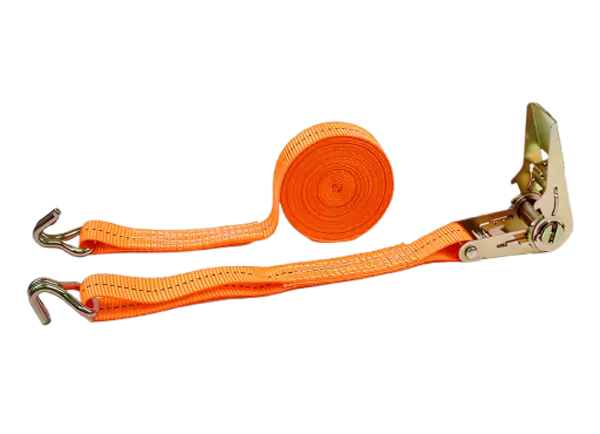
Ratchet tie-down straps use a mechanical ratchet to tension the webbing. They allow users to apply controlled tension and are commonly used for trailers, trucks, machinery, building materials, and other cargo that requires firm restraint.
These straps are often suitable for applications where greater tension control is necessary. However, the tensioning mechanism must be operated correctly, and excessive tightening can damage cargo or create unnecessary stress on the strap assembly.
When evaluating ratchet straps, check the rated capacity of the complete assembly, the condition of the ratchet, the quality of the stitching, and the compatibility of the end fittings with the anchor points.
Cam Buckle Tie-Down Straps
Cam buckle tie-down straps use a spring-loaded mechanism that grips the webbing when tension is applied. They are generally straightforward to adjust and release.
These straps are often suitable for lighter cargo, camping equipment, bicycles, household items, and other applications that do not require the high tension commonly associated with ratchet mechanisms.
Because cam buckle straps can be easier to adjust without applying excessive force, they may be useful when securing goods that could be damaged by overtightening.
The product's actual working load limit must still be checked before use.
Other Buckle and Hook Configurations
Some cargo tie-down straps feature simple buckles, flat hooks, wire hooks, snap hooks, or other end fittings. The right configuration depends on the cargo, anchor points, and required securing arrangement.
Hooks should fit the intended anchor points securely without being forced into an unsuitable position. Improvised connections, incompatible hardware, or side loading can compromise the restraint system.
When comparing strap designs, evaluate the entire assembly rather than focusing on the buckle or hook in isolation.
5. Check the Working Load Limit and Breaking Strength
Load ratings are among the most important factors when buying tie-down straps. A product may look durable but still be unsuitable for a particular cargo-securing task if its rated capacity is insufficient.
What Is the Working Load Limit?
The working load limit specifies the maximum load that a product is rated to handle under the conditions stated by its manufacturer. It provides a practical basis for determining whether a strap is suitable for an intended application.
The required capacity depends on the cargo weight, restraint configuration, direction of potential movement, number of securing points, and applicable regulations.
It is important to understand that the number of straps used does not automatically determine the total allowable capacity. Load sharing may be uneven, and the effectiveness of each strap depends on its orientation, the anchor points, and the overall arrangement.
What Is Breaking Strength?
Breaking strength refers to the force at which a strap or strap assembly fails under specified testing conditions. It is generally higher than the working load limit.
Buyers should never use breaking strength as the normal operating capacity of a tie-down strap.
When comparing products, confirm that the stated rating applies to the complete assembly, including the webbing, stitching, buckle or ratchet, and end fittings. A high-strength webbing component cannot compensate for an inadequately rated buckle or hook.
Why Load Ratings Must Be Verified
For commercial transportation, incorrect load ratings can lead to cargo movement, equipment damage, and compliance problems. Different jurisdictions and applications may also have specific requirements for cargo securement.
Always follow the manufacturer's instructions and relevant transportation regulations. Where necessary, consult a qualified cargo-securement professional to determine the required restraint capacity and configuration.
6. Consider the Cargo-Securing Method
Even high-quality tie-down straps cannot perform effectively if they are used in an unsuitable configuration. The way a strap is positioned affects how it controls movement during braking, turning, acceleration, and changes in road conditions.
Direct Restraint
Direct restraint connects the cargo to suitable anchor points so that the securing system helps prevent movement in specific directions.
This approach may be appropriate for machinery, equipment, and loads with suitable attachment points. The strength and location of the cargo attachment points must be considered alongside the strap ratings.
Over-the-Top Tie-Downs
Over-the-top tie-downs pass over the cargo and apply downward force to help increase friction between the load and the supporting surface.
This method may be appropriate for certain pallets, bundles, and other cargo types, provided the load and securing arrangement are suitable.
However, downward pressure alone may not be sufficient to prevent movement in every direction. The number, placement, and tension of the straps must reflect the cargo characteristics and applicable requirements.
Use Appropriate Anchor Points
Anchor points must be rated for the forces expected in the securing arrangement. A strong strap attached to a weak or damaged anchor point does not provide a reliable system.
Inspect the anchor points, vehicle structure, and cargo attachment locations before use. Avoid attaching straps to components that are not designed to withstand securing forces.
For loads with sharp corners, use suitable edge protectors to prevent abrasion or cutting of the webbing.
7. Evaluate Durability and Environmental Resistance
Tie-down straps may be exposed to rain, sunlight, dust, dirt, oil, temperature changes, and repeated handling. The operating environment can influence both service life and product suitability.
UV and Weather Exposure
For outdoor transportation, consider the webbing's resistance to ultraviolet exposure and the manufacturer's stated environmental limitations.
Repeated or prolonged sunlight exposure can degrade synthetic fibers over time. If straps are regularly stored on trailers or used outdoors, inspect them more frequently and replace them when damage or deterioration is identified.
Moisture-resistant materials may be helpful in wet environments, but moisture resistance does not mean the entire assembly is suitable for every outdoor or marine application.
Abrasion and Edge Protection
Repeated friction against metal edges, concrete surfaces, or rough cargo packaging can wear down webbing fibers. Sharp edges may cause damage much more quickly.
Use suitable edge guards, sleeves, or protective materials where necessary. These accessories can help reduce direct contact between the webbing and abrasive surfaces.
Cleaning and Storage
After use, remove dirt and debris according to the manufacturer's care instructions. Allow wet straps to dry appropriately before storage, and keep them away from chemicals, excessive heat, and other damaging conditions.
Store tie-down straps in a clean, dry location where they will not be crushed, cut, or exposed to unnecessary sunlight.
Regular inspection and proper storage can help extend service life, but they do not replace the need to remove damaged straps from service.
8. Inspect Tie-Down Straps Before Every Use
Routine inspection is an important part of cargo safety. Even straps with suitable ratings can become unsafe through wear, improper handling, or exposure to damaging conditions.
Before each use, examine the webbing for cuts, fraying, broken stitching, melted areas, chemical damage, and other signs of deterioration. Inspect ratchets, buckles, hooks, and connecting hardware for deformation, cracks, corrosion, or malfunction.
Pay particular attention to areas that repeatedly contact cargo edges or pass through fastening mechanisms.
A strap should be removed from service when it shows damage that compromises its integrity or when its identification and rating cannot be verified as required. Do not repair a load-bearing tie-down strap with ordinary stitching, knots, or improvised hardware.
Inspection procedures should follow the manufacturer's recommendations and any applicable industry standards.
9. Match Tie-Down Straps to Specific Applications
Different industries have different cargo-securing requirements. Selecting products based on the intended application can improve handling efficiency and reduce the risk of choosing an unsuitable design.
Transportation and Logistics
Truck drivers and logistics companies often use cargo tie-down straps to secure palletized goods, cartons, industrial components, and other freight.
For these applications, buyers should prioritize clearly marked load ratings, compatible end fittings, appropriate lengths, and resistance to routine handling wear.
Standardized strap specifications can also help fleet operators simplify inventory management.
Construction and Industrial Equipment
Construction materials and industrial machinery may have substantial weight, irregular shapes, or concentrated contact points. Heavy-duty tie-down straps may be appropriate when their ratings and securing configuration meet the requirements of the load.
Equipment with sharp edges or unstable centers of gravity may require additional protection or a different restraint method. Always assess the complete cargo and transport arrangement.
Automotive, Motorcycle, and Recreational Equipment
Tie-down straps are also used to secure motorcycles, recreational vehicles, tools, and outdoor equipment during transportation.
In these situations, buyers should consider the cargo's balance, available anchor points, suspension or moving components, and the potential for surface damage. Suitable soft loops or protective sleeves may help prevent direct contact between metal hooks and finished surfaces.
The securing method should be appropriate for the specific vehicle or equipment rather than relying on a single universal arrangement.
Warehousing and General Handling
In warehouses and distribution centers, tie-down straps can help secure goods during internal movement or temporary storage when the application permits their use.
Easy adjustment, manageable strap length, durable webbing, and clearly identified ratings can be important selection criteria for frequent handling operations.
10. Evaluate the Manufacturer and Product Quality
For distributors, importers, fleet operators, and businesses purchasing tie-down straps in bulk, choosing a reliable manufacturer is as important as selecting the correct product specifications.
A professional supplier should provide clear product information, consistent manufacturing quality, and technical documentation that supports purchasing decisions.
Review Product Specifications
Check whether the manufacturer provides information about webbing material, strap dimensions, working load limit, breaking strength, hardware, stitching, and intended applications.
Product labels and documentation should make it possible to identify the relevant rating and usage limitations. Avoid relying on vague descriptions such as "extra strong" or "heavy duty" without supporting specifications.
Check Manufacturing Consistency
For bulk orders, consistent quality helps reduce variations between individual products. Buyers should consider how the manufacturer controls raw materials, webbing production, stitching, hardware assembly, inspection, and finished-product identification.
Where applicable, ask about load testing, quality-control procedures, traceability, and conformity with relevant standards.
Consider OEM and Customization Services
Some businesses need custom tie-down straps to match specific cargo dimensions, equipment designs, brand requirements, or distribution channels.
Potential customization options may include strap length, webbing width, color, end fittings, labels, packaging, and branding. Not every manufacturer offers every option, so confirm the available specifications before placing an order.
For wholesale buyers, it is also useful to evaluate communication, sample availability, order consistency, production capacity, and lead-time management.
A supplier that understands the intended application can help buyers narrow down suitable products rather than recommending the same strap configuration for every load.
11. Common Mistakes to Avoid When Choosing Tie-Down Straps
Several purchasing and usage mistakes can reduce the effectiveness of a cargo-securing system.
Choosing straps based only on appearance: Thick webbing or large metal hooks do not automatically indicate a suitable working load limit. Verify the complete assembly rating.
Ignoring the cargo's shape: Irregular or fragile loads may require additional protective accessories or a different securing method.
Using the wrong fastening mechanism: Ratchet straps and cam buckle straps are designed for different tensioning needs. Select the type that suits the cargo and application.
Assuming multiple straps always provide sufficient capacity: Uneven loading, poor positioning, weak anchor points, and unsuitable angles can reduce the effectiveness of the securing system.
Overtightening the straps: Excessive tension can damage cargo, distort packaging, or place unnecessary stress on the strap assembly.
Continuing to use damaged straps: Frayed webbing, defective stitching, damaged hardware, and illegible identification can create avoidable risks. Remove unsuitable products from service.
Avoiding these mistakes starts with understanding the cargo, verifying the product specifications, and following a consistent inspection and securing procedure.
Conclusion
Choosing the right tie-down straps for your cargo requires a systematic evaluation of load weight, cargo dimensions, webbing material, strap width and length, fastening mechanism, working load limit, and transportation conditions. Buyers should also consider the securing configuration, anchor-point strength, environmental exposure, and long-term product quality.
For occasional users, matching the strap to the cargo and following the manufacturer's instructions are essential first steps. For commercial buyers, evaluating manufacturing consistency, technical documentation, customization capabilities, and supplier reliability can help support safer and more efficient operations.
Whether you need polyester cargo straps for logistics, ratchet tie-down straps for heavy equipment, or customized solutions for specialized transportation requirements, selecting products according to their verified specifications is more important than choosing by appearance alone. With a focus on quality, appropriate application, and responsible use, Zhongyi aims to support customers in identifying tie-down strap solutions that meet their cargo-securing needs and operational requirements.
RELATED NEWS
-
 Industry News Jul. 04, 2025Inside the Standard: EN 12195-2 and What It Means for Web Lashing SafetyRead More

-
 Industry News Jul. 04, 2025Why Round Slings Are a Go-To Solution for Modern, Complex LiftsRead More
-
 Industry News Jul. 04, 2025Tech Advancements: The Evolution of Tensioning Devices in Load SecurementRead More


